A pigment Xia Peng had used for years changed its formula. New environmental regulations, a manufacturer’s adjustment. The colour he needed simply stopped behaving the way it always had. He had to find another way. This is a small thing and also not a small thing. It names something that runs through this entire exhibition: what it means to keep working within forms that have quietly shifted beneath you, and that you cannot simply replace.
He is not alone in this. The sense that established methods, inherited certainties, and forward momentum have quietly stopped working is not private. It is the particular texture of the present moment. Not necessarily a crisis as crisis implies a breaking point, something that resolves into before and after. This is slower and harder to name. Things continue. The work continues. But the ground has shifted and there is no going back to the position you held before you noticed.
Xia Peng trained in ink painting at the prestigious Central Academy of Fine Arts (CAFA) in Beijing before studying painting at Kunsthochschule Kassel in Germany. He has lived and worked in Berlin for over a decade. In Chinese ink painting, the unpainted surface is not empty. It breathes. What is left out produces meaning alongside what is put down. In the Western painterly tradition he encountered in Germany, the canvas is a field to be worked and reworked, time deposited through material accumulation. Both instincts are active in these paintings. Neither has been made to serve the other. The upper registers thin toward atmosphere while the lower thicken into near-opacity. Two understandings of what a surface is for, sitting alongside each other without resolution. Chapters from different books, placed on the same shelf and left unsorted.
The small works make this most literal. In “Bücher,” books are painted onto books. In “Venus,” a classical nude occupies a narrow painted strip between two panels of bare, unpainted hardcover. Xia Peng has said he is not interested in telling the stories inside books; he wants to tell the story of books themselves, their fate as objects. There is a feeling, he says, that comes from browsing a secondhand bookshop: the sensation of an era having passed. These objects that once carried knowledge, sequence, and the assumption that one thing follows from another now sit displaced from whatever life they belonged to. He describes this attachment in terms of 执念 (zhí niàn), a Chinese concept that holds together the spiritual weight of clinging and the simple human inability to let go. The book works are about that: not so much about what is stored but the act of storing, not the story but the object that was meant to carry it forward into a future that has stopped feeling like a direction.
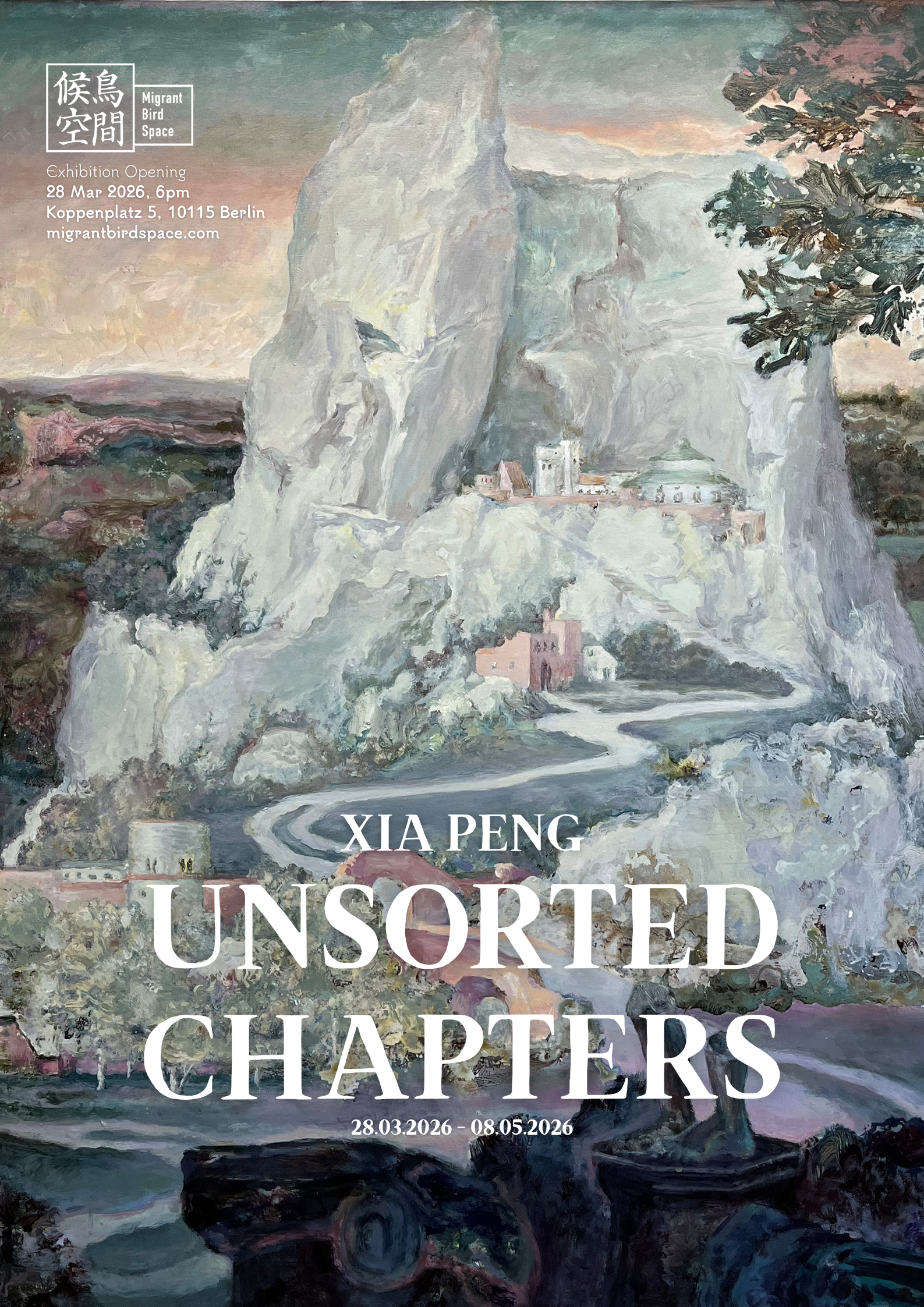
The large canvases hold the same feeling at a different scale and a different duration. “Bergstraße (Mountain Road)” took years. Xia Peng has described returning to it repeatedly, reworking passages, finding that what had come easily before would no longer come. The dark passages in the lower foreground were left empty for a long time because nothing belonged there, until he found a detail borrowed from the Renaissance source image the mountain's structure derives from, a severed foot, buried in dark paint where it is easy to miss. Above it, the mountain follows the vertical logic of Song dynasty landscape painting, where a towering peak embodies cosmic order and draws the gaze upward. But the mountain is settled with European domes, towers, and arched bridges. A path winds through and deposits the eye nowhere. The painting holds this without explaining it, the way a person holds two incompatible things because there is no mechanism for setting either one down.
The mythological canvases name large ancient stories and then decline to tell them. Xia Peng points out that religious iconography was never as stable as we assume; stories were mistranslated, locally adapted, contradicted across sources (those who are unfamiliar with Claude Lévi-Strauss might be reminded of his discourse on how myths are made and die). He uses these images not to transmit original meaning but because their accumulated instability creates interpretive space rather than closing it down. Art, he says, is pure fiction; and by which he means not that it is false, but that it is free from the obligation to resolve what it touches.
These paintings were made in Berlin, and something of the city has entered them. It’s the experience of walking the same street for years and noticing that the buildings don't quite account for each other, that the ground beneath holds foundations from different times, that the marks left on a single wall by different decades simply coexist without anyone having organised them into sense. Nobody sorts it. It just sits there, layered, each part legible on its own terms and unresolved in relation to the others. This is the same structure as these paintings: two traditions present on the same surface, neither subordinated, neither explained.
Unsorted Chapters takes its name from what you find here: everything present, nothing filed. The traditions, the symbols, the figures, the surfaces: each legible, none arranged into a sequence that tells you what comes first or where it is all heading. Xia Peng has described the goal of a single work, and of an exhibition, in the same terms: to produce an energy, a state, something that makes you want to stay, to remain inside the experience of looking at material that is still, stubbornly, in the process of becoming.
Written by Lu Mei &
Zhi Zhi Chia